A PCB assembly may pass functional testing and still develop problems after prolonged exposure to moisture, dust, or corrosive environments. These conditions can contribute to corrosion, electrical leakage, and electrochemical migration, affecting product reliability over time.
Conformal coating adds a thin protective film to a printed circuit board assembly (PCBA), helping reduce these environmental risks.
Vosnor has added in-house automated conformal coating to its PCBA manufacturing process, giving customers another option for protecting electronic assemblies without routinely sending them to an external coating supplier.
Why Use Conformal Coating on PCB Assemblies?
Conformal coating covers selected areas of a PCB assembly, including components and solder joints that require environmental protection. Depending on the coating material and application process, it can help limit moisture-related damage, reduce contamination risks, and protect against certain corrosive conditions.
It is particularly worth considering for industrial control boards, outdoor IoT devices, agricultural electronics, and other products exposed to humidity or environmental contaminants.
Unlike potting, conformal coating forms a relatively thin film rather than fully encapsulating the assembly. Inspection and rework may remain possible, depending on the coating material and application.
How Automated Conformal Coating Improves Process Control
Manual coating can be suitable for some projects, but consistent coverage across production batches can be difficult to maintain. Connectors, test pads, and contact pins must also remain free of coating where required.
Vosnor’s automated coating equipment helps control application paths and dispensing parameters, supporting more repeatable coverage and reducing operator-dependent variation.
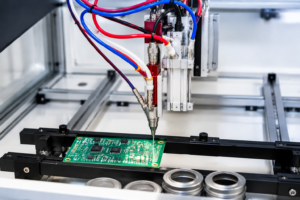
Key advantages include:
- Selective application: Programmed paths help target designated coating areas and avoid specified keep-out zones.
- Consistent coverage: Controlled dispensing helps improve repeatability across production runs.
- Fewer external handoffs: In-house coating reduces the need to transfer assemblies to a separate supplier.
- Integrated manufacturing: Coating requirements can be coordinated with assembly, inspection, and testing.
Image: Vosnor’s automated conformal coating equipment.
The actual process depends on PCB layout, masking requirements, film thickness, and curing conditions. Appropriate inspection and process validation remain essential.
Choosing the Right Coating for Your PCBA
Acrylic, polyurethane, and silicone are common conformal coating materials, each with different characteristics. Selection depends on operating temperature, humidity, chemical exposure, curing requirements, and repairability. UV-curable formulations may also be suitable for certain applications.
For projects specifying IPC-CC-830, the applicable requirements and material documentation should be reviewed during process planning. Automated equipment alone does not establish compliance with the standard.
PCBA Manufacturing and Testing at Vosnor
Vosnor provides PCBA manufacturing services covering SMT assembly, DIP through-hole assembly, AOI inspection, functional testing, and in-house conformal coating according to project requirements.
Coordinating these processes helps reduce external handoffs and keeps manufacturing requirements aligned across production stages.
Explore our turnkey PCBA manufacturing services and PCB testing and inspection capabilities to learn more about our manufacturing and quality-control processes.
Discuss Your PCBA Requirements with Vosnor
If your electronic products operate in humid, dusty, outdoor, or potentially corrosive environments, conformal coating may be worth considering as part of your reliability strategy.
Contact Vosnor to discuss your PCB design, operating environment, production volume, and coating requirements. Our team can review your project and discuss suitable manufacturing options.