Most PCBA delays do not start on the production line. They start in the enquiry — with a bill of materials (BOM) that cannot be priced, a missing placement file, or a test requirement mentioned for the first time after the boards are built. The good news is that a complete request-for-quotation (RFQ) package is neither long nor difficult. This checklist is the exact package that lets a manufacturer review manufacturability, check component availability, and return a quote you can actually compare — plus the nine mistakes that most often send a project back for another round of questions.
The complete RFQ package
| 文件 | What to include | Why it matters |
|---|---|---|
| BOM (spreadsheet) | Manufacturer part number (MPN), manufacturer, description, quantity per board, reference designators for every line | Drives sourcing, pricing and substitution control |
| Gerber format / board files | Released revision of fabrication data (or ODB++/board files where used) | Defines the bare board and assembly revision |
| Placement data (CPL) | Pick-and-place / XY file with coordinates and rotation | Programmes the SMT machines; missing data means manual reconstruction |
| 组装图纸 | Polarity, orientation, special instructions, do-not-populate (DNP) parts clearly marked | Prevents assembly errors |
| Quantity & schedule | Prototype and expected production quantities, target delivery date | Price and lead time are quantity- and availability-dependent |
| Firmware & programming | Firmware file/version and programming method, if programming is in scope | Must be planned into the line, not added afterwards |
| 测试要求 | Test procedure, pass/fail limits, fixture information, required records | Test scope changes both price and schedule |
| Mechanical / box build data | Enclosure drawings, harness data, labelling and packaging, if integration is in scope | Defines the integration, labelling and packaging scope |
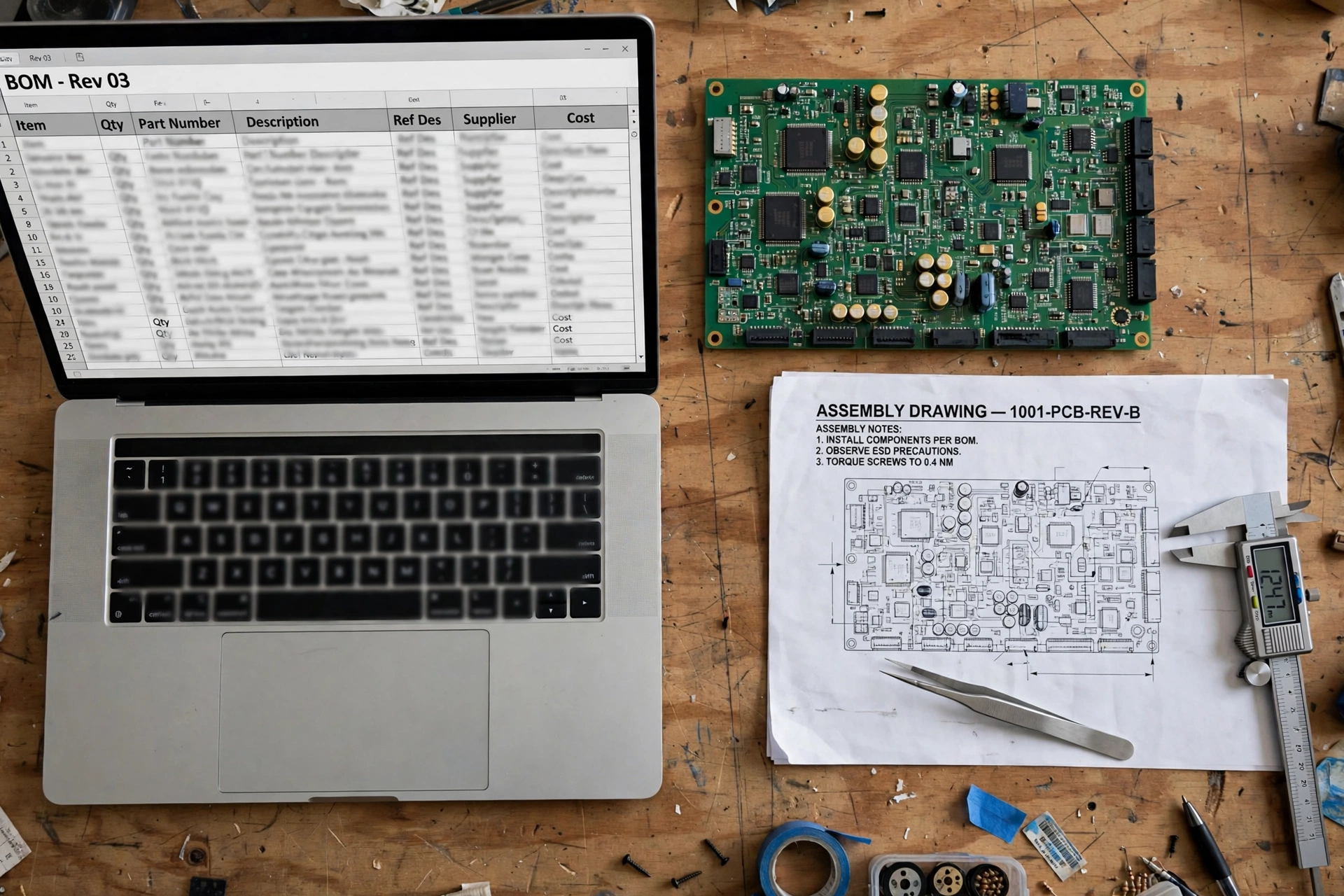
BOM checklist and Gerber files required for a PCBA quotation.
Incomplete data is not a barrier to starting: if some files are still being prepared, say what you have and what is pending, and a good engineering team will tell you the next piece of information it needs. What causes delay is not incompleteness itself — it is incompleteness discovered late.
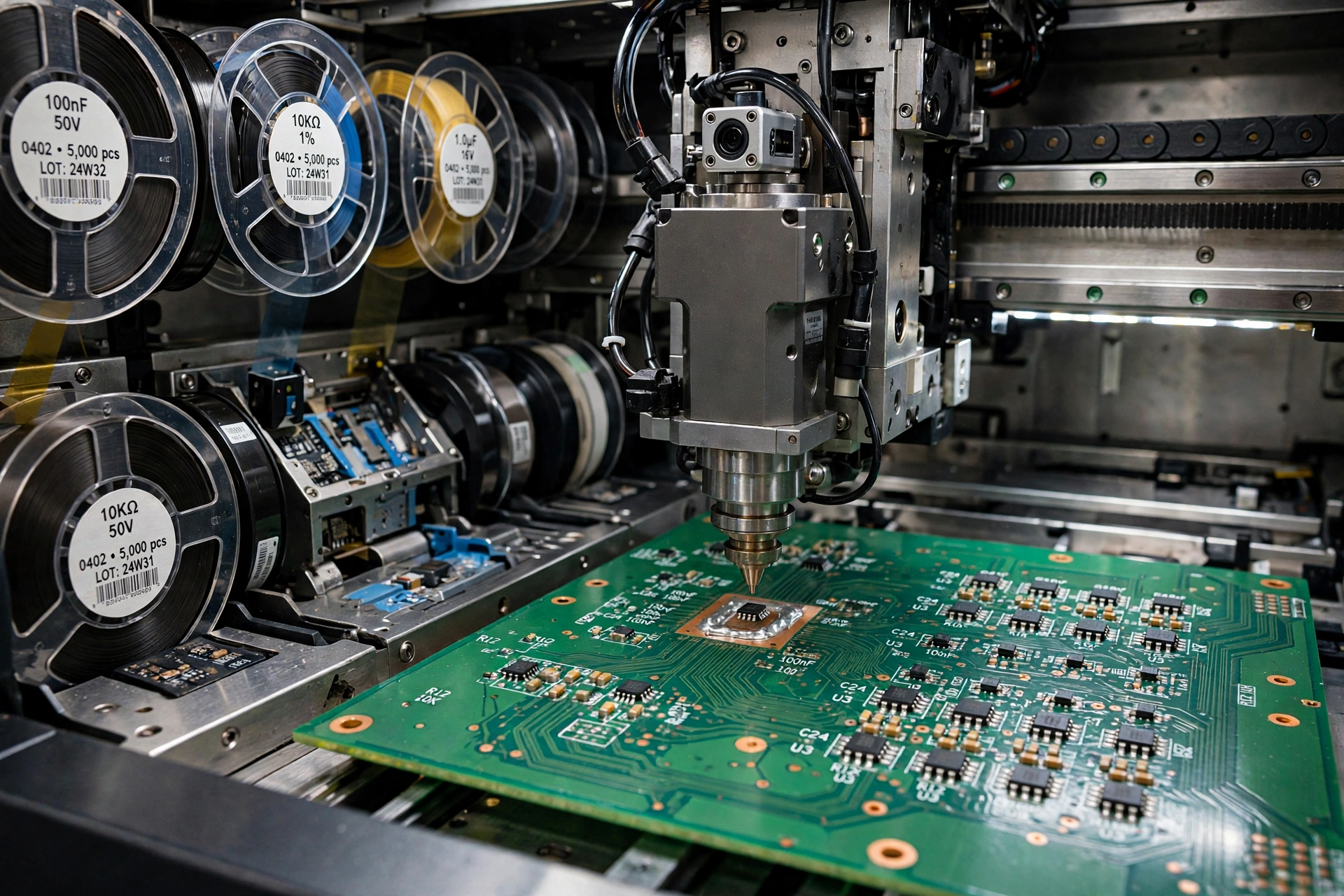
Placement pick and place data for SMT PCB assembly programming.
The 9 BOM mistakes that delay production
- Missing manufacturer part numbers. ’10k resistor 0603′ is a description, not a purchasable part. Without MPNs the factory must guess — or stop and ask.
- No reference designators. Quantities without designators cannot be checked against placement data, and DNP parts become guesswork.
- BOM and board revision mismatch. A Rev B BOM against Rev A Gerbers guarantees an engineering query at best and a wrong build at worst. State the released revision of every file.
- Unmarked DNP / alternative parts. Parts fitted only on some variants must be marked as such, with the variant rule stated.
- No approved alternatives for risky parts. For single-source, long-lead or end-of-life parts, pre-approving an alternative at RFQ stage is the cheapest insurance in the whole project.
- Package/footprint inconsistencies. A part specified in one package while the footprint is another is a classic DFM catch — far better caught in review than at first article.
- Firmware or test needs mentioned too late. Programming method, test access and pass/fail limits affect line setup and fixtures. Raise them with the RFQ, not after assembly.
- Quantities without attrition allowance (consigned builds). If you supply parts, small components need overage for handling loss. Agree quantities and shortage responsibility before shipping.
- One combined file with no version control. Send files as a clearly named, dated package. Gerber/CAD bundles are best sent as a single ZIP so revisions cannot drift apart.
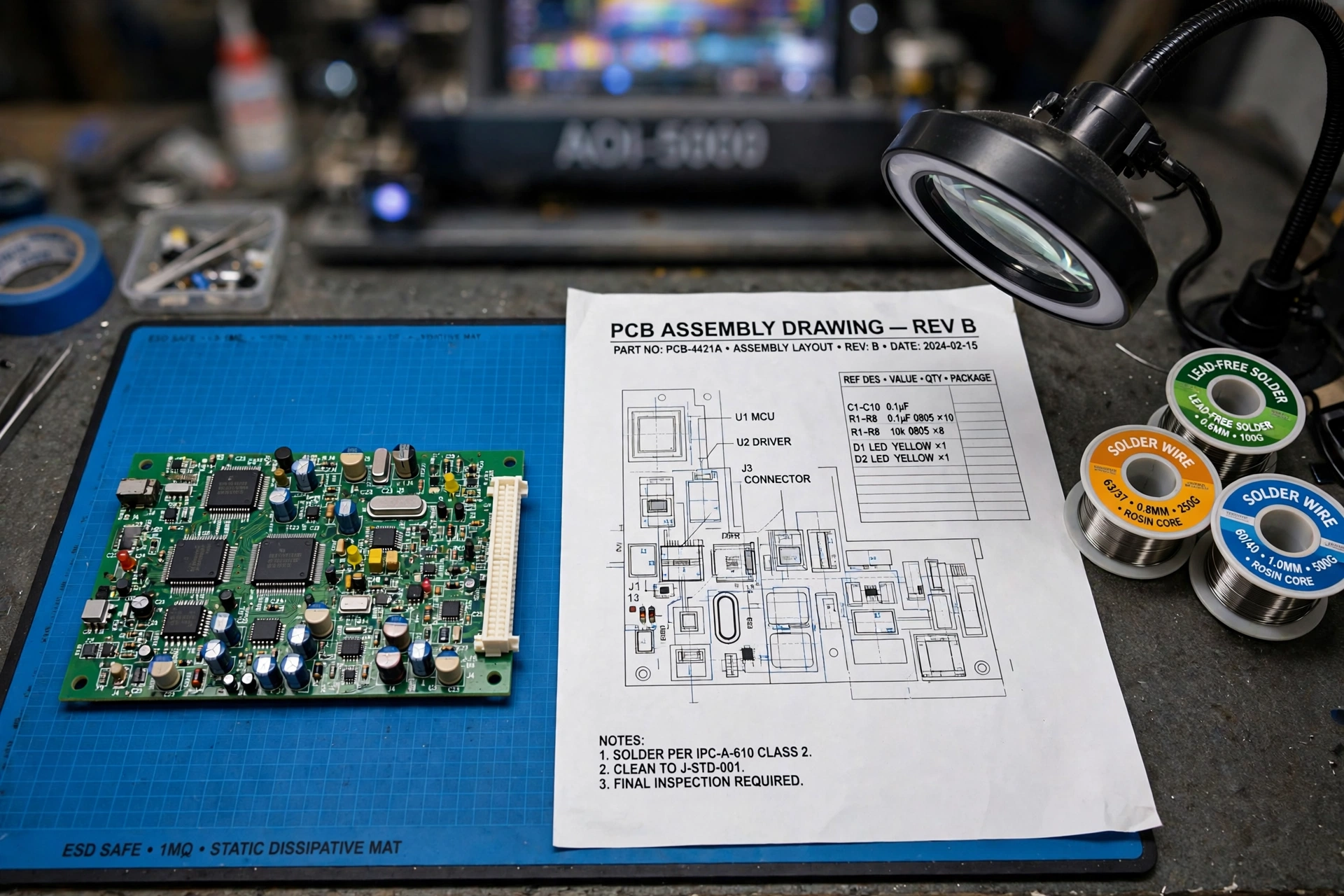
Assembly drawing — Rev B, with reference designators, polarity and DNP markings.
What happens after you send the package
Expect engineering questions before a final quote — that is the system working. A structured review resolves BOM and manufacturability questions, confirms critical components, agrees the test plan, and only then confirms price and schedule against real material availability. At Vosnor, every enquiry is reviewed by the production engineering team before a response, and substitutions identified during sourcing are submitted for your approval before procurement. If a supplier quotes instantly with no questions on a complex board, it has not reviewed your files; it has guessed at them.
If you are still comparing suppliers, read how to choose a PCBA manufacturer in China and review Vosnor’s PCBA制造能力. When you are ready, send your files for a quote.
常见问题
Can I get a PCBA quote with only a BOM?
You can get an early indication, but not a reliable production quote. Without board files and placement data the factory cannot verify footprints, placement count or test access. Send what you have, state what is pending, and expect the quote to firm up as the package completes.
What format should the BOM be in?
A spreadsheet (Excel/CSV) with one row per part: manufacturer part number, manufacturer, description, quantity per board and reference designators. Mark DNP and variant parts clearly, and state the BOM revision.
Do I need to send Gerber files, or is a PDF of the board enough?
Gerber (or equivalent fabrication/board data) is needed for a production review. A PDF or board photo helps an early conversation but cannot drive fabrication, placement programming or a firm quote.
How should I send large design files?
Bundle Gerber/CAD data into a single ZIP with a clear revision name. On vosnor.com the enquiry form accepts multiple attachments within its stated size limits; email to inquiry@vosnor.com works for larger packages — confirm receipt if the package is critical.
Send your BOM and Gerber files for a free engineering review at vosnor.com/contact or email inquiry@vosnor.com. Every enquiry is reviewed by Vosnor’s production engineering team in Dongguan before a quotation is prepared — no commitment required.